Software Development
Border Control Software Development for African Nations (2026 Guide)
- Written by
Shishu Yadav - Posted on
Jun 29, 2026
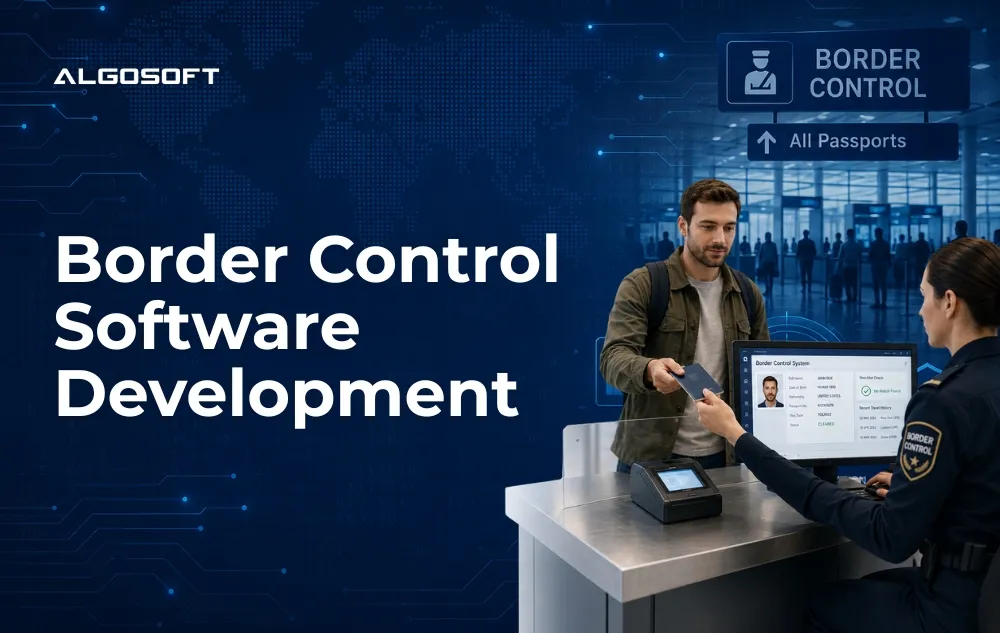
Border security across Africa sits at the intersection of national security, migration management, and trade facilitation — three priorities that often pull in different directions when border infrastructure relies on manual, paper-based processes. From Nigeria’s land borders with Benin, Niger, and Cameroon, to Kenya’s porous frontiers with Somalia and South Sudan, Ghana’s coastal and land entry points, South Africa’s heavily trafficked border posts, and the security-sensitive borders of Libya and Somalia, the case for modern border control software development has never been stronger.
This guide covers what a comprehensive border control system includes, the biometric and AI technologies reshaping border security in Africa, realistic development costs, and how governments should evaluate a development partner for a system this sensitive.
Migration Management — Reliable border data is essential for managing both regular and irregular migration flows, particularly along Africa’s most active migration corridors through Libya and the Horn of Africa.
Counter-Terrorism and Security — Real-time watchlist screening and biometric verification at border crossings are critical tools for identifying security threats before they cross into national territory.
Trade Facilitation — Border posts that also serve as trade corridors need systems that balance rigorous security screening with the throughput speed required to keep AfCFTA-driven trade volumes moving.
International Donor Requirements — Many African border modernization projects are funded in part by international partners (IOM, EU border assistance programs, US security cooperation funding) that require specific data standards and interoperability commitments.
Biometric Identity Verification Fingerprint, facial recognition, and iris scanning capabilities that verify traveler identity against national ID databases and international watchlists in real time.
Advance Passenger Information (API) and Passenger Name Record (PNR) Processing Automated processing of airline and carrier-submitted passenger data ahead of arrival, allowing border officers to pre-screen travelers before they reach the physical checkpoint.
Watchlist and Interpol Database Screening Real-time cross-referencing against national security watchlists and international databases like Interpol’s stolen and lost travel documents database.
Land Border Crossing Management Purpose-built workflows for land border posts, which often face very different connectivity and infrastructure constraints than international airports.
Visa and Entry Permit Integration Seamless verification of electronic visas and entry permits issued through national e-visa platforms, reducing both processing time and fraud risk.
Risk Profiling and Analytics AI-assisted risk scoring that helps border officers prioritize secondary screening for travelers exhibiting unusual travel patterns or documentation anomalies.
Inter-Agency Data Sharing Secure integration with immigration, customs, national police, and intelligence services to create a unified picture of border activity.
Facial recognition and biometric matching have become central to modern border security, but deploying them effectively requires careful engineering. A well-built system pairs Machine Learning Solutions with rigorous testing across diverse populations to avoid the accuracy gaps that have historically affected biometric systems trained on non-representative datasets — a particularly important consideration for systems deployed across Africa’s diverse populations.
Beyond identity matching, AI-driven anomaly detection can flag unusual travel patterns, document inconsistencies, or behavioral indicators that warrant additional screening — all built on a foundation of solid Data Engineering & AI Pipelines work to ensure the underlying data is clean, structured, and reliable.
| Project Scope | Estimated Cost Range (USD) | Typical Timeline |
| Single Border Post Pilot | $60,000 – $150,000 | 3–5 months |
| Multi-Post Regional Rollout | $200,000 – $500,000 | 8–14 months |
| National Border Management Platform | $500,000 – $1.2M+ | 14–24 months |
Costs scale significantly based on the number of border posts, whether biometric hardware procurement is included, and the depth of inter-agency integration required.
Nigeria — With multiple active land borders and high migration and trade volumes, Nigerian border control projects typically prioritize watchlist screening and integration with the National Identity Management Commission’s biometric database.
Kenya — Kenya’s border posts with Somalia carry significant security sensitivity, making robust biometric verification and real-time intelligence sharing particularly important design priorities.
Ghana — As a relatively stable West African hub, Ghana’s border modernization efforts often focus on trade facilitation alongside security, balancing throughput speed with screening rigor.
South Africa — South Africa’s border posts handle some of the continent’s highest cross-border traffic volumes, requiring high-throughput biometric processing capable of handling large daily passenger numbers without creating bottlenecks.
Libya — Given ongoing institutional rebuilding, Libyan border control projects often benefit from modular, phased deployment that can function even where full national identity infrastructure is still being established.
Somalia — Border control digitization in Somalia frequently starts with foundational capability — basic biometric capture and watchlist screening — given the more limited baseline IT infrastructure compared to other countries in this list.
Land border posts across much of Africa face unreliable power and internet connectivity, making system architecture decisions critical to real-world success:
Border control systems handle some of the most sensitive data any government manages, making generic, off-the-shelf platforms a poor fit for most African deployments. A properly engineered custom software development approach allows for:
Algosoft’s Data Protection & Privacy and Network & Infrastructure Security capabilities support government clients building systems where data sensitivity and security are paramount design considerations, not afterthoughts.
How long does it take to deploy a border control software system?
A single border post pilot can launch in 3–5 months, while a full national platform spanning multiple posts typically takes 14–24 months.
How much does border control software development cost?
Costs range from roughly $60,000 for a single border post pilot to $1.2 million or more for a comprehensive national platform, depending on scope and biometric hardware requirements.
Can border control systems work at remote land border posts with poor connectivity?
Yes, with offline-first architecture that caches data locally and synchronizes automatically once connectivity is restored — essential for many rural border posts across Kenya, Libya, and Somalia.
How accurate is facial recognition technology for diverse African populations?
Accuracy depends heavily on whether the underlying AI models were trained and tested on representative datasets. This is a critical evaluation point when selecting a development partner for any biometric border control system.
Do border control systems need to integrate with national ID databases?
Yes — the most effective border control systems integrate directly with national identity management systems to verify traveler identity accurately and avoid duplicate data entry.
Border control software development sits at the intersection of national security, migration management, and trade facilitation — and getting the technology right has real consequences for citizen safety and economic competitiveness. Whether your government is planning a single pilot border post or a full national rollout across Nigeria, Kenya, Ghana, South Africa, Libya, or Somalia, choosing a development partner with proven security architecture experience and genuine understanding of African infrastructure realities is essential.
Ready to discuss a border control modernization project? Talk to Algosoft.

If you are budgeting a software project in 2026, the single question that decide..

When to Build Custom Software is a crucial decision that can shape your business..

“How much will it cost?” is the first question almost every Nigerian..

Logistics is one of Nigeria’s fastest-growing sectors. E-commerce delivery..

Artificial intelligence has moved from buzzword to boardroom priority across Nig..

Nigeria has become the beating heart of Africa’s technology scene. Lagos a..

A Dedicated Software Development Team for Kenya is the ideal solution for busine..

India vs Kenya Software Development Cost Comparison is a key consideration for b..

Kenya Businesses Outsource Software Development to India for several strategic r..

Finding the right Software Outsourcing Company for Ghana is a critical decision ..
Typically replies instantly
Share this article