Customs Management System Development
Customs Management System Development for African Governments (2026 Guide)
- Written by
Shishu Yadav - Posted on
Jun 29, 2026
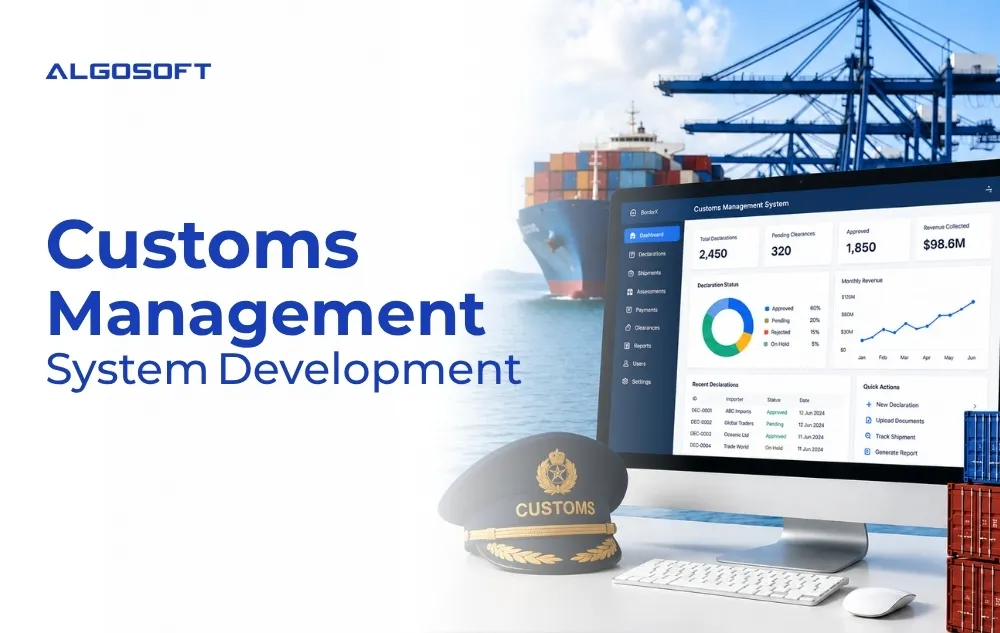
Africa’s trade volumes are growing faster than most legacy customs infrastructure can handle. From the Lagos and Lekki ports in Nigeria to Mombasa in Kenya, Tema in Ghana, Durban in South Africa, Tripoli in Libya, and Mogadishu and Berbera in Somalia, customs authorities across the continent are under mounting pressure to clear cargo faster, close revenue leakages, and meet the trade facilitation commitments of the African Continental Free Trade Area (AfCFTA).
Manual, paper-heavy customs processing simply cannot keep up. This is why customs management system development has become one of the highest-priority digital transformation investments for revenue authorities, port operators, and trade ministries across Nigeria, Kenya, Ghana, South Africa, Libya, and Somalia.
This guide breaks down what a modern customs management system includes, the technology decisions that matter most, realistic development costs, and how African governments can choose the right software development partner for a project this critical.
AfCFTA Compliance — The African Continental Free Trade Area requires harmonized, digitized trade documentation and faster cross-border clearance, putting direct pressure on national customs systems to modernize.
Revenue Leakage — Manual customs processing creates opportunities for under-declaration, misclassification, and outright corruption. A properly engineered customs management system creates an auditable digital trail that significantly reduces revenue loss — a priority for revenue-dependent economies like Nigeria and Ghana.
Port Congestion — Ports in South Africa and Kenya regularly face congestion driven by slow manual clearance processes. Automated risk-based clearance and electronic documentation directly reduce dwell time and demurrage costs for importers.
Donor and IFI Pressure — The World Bank, IMF, and regional development banks increasingly tie trade facilitation funding to demonstrated progress on customs digitization, particularly in Somalia and Libya as part of broader institution-building efforts.
A comprehensive customs management system typically includes the following functional modules:
Electronic Single Window A unified digital portal where importers, exporters, and freight forwarders submit declarations, supporting documents, and permits in one place, eliminating the need to visit multiple government offices physically.
Risk-Based Cargo Selectivity Automated risk scoring that flags high-risk shipments for physical inspection while allowing low-risk cargo to clear quickly — reducing both fraud and unnecessary delays for compliant traders.
Duty and Tariff Calculation Engine Automated HS code classification and duty calculation based on current tariff schedules, reducing both human error and opportunities for manipulation.
Revenue Collection and Reconciliation Integrated electronic payment processing with real-time reconciliation against national treasury systems, closing common revenue leakage points.
Cargo Tracking and Bonded Warehouse Management Real-time visibility into cargo movement from port of entry through bonded warehouses to final clearance, reducing diversion and smuggling risk.
Inter-Agency Data Sharing Secure data exchange with port authorities, immigration, tax authorities, and central banks to eliminate duplicate data entry and create a single source of truth across government.
Analytics and Reporting Dashboards Real-time visibility for customs leadership into clearance times, revenue collection, inspection rates, and officer performance.
Cloud vs On-Premises Deployment Many African customs authorities are moving toward hybrid cloud architectures — keeping sensitive revenue data on secure local infrastructure while using cloud capacity for analytics and reporting, balancing data sovereignty requirements with the scalability cloud platforms provide.
Interoperability Standards A well-built customs system should support WCO Data Model standards and API-based integration, allowing it to connect smoothly with regional trade systems as AfCFTA implementation deepens.
Offline Resilience For border posts in regions with unreliable connectivity — a real consideration across rural Kenya, Libya, and Somalia — the system architecture needs offline-capable functionality with automatic synchronization once connectivity is restored.
Security and Audit Trails Given the revenue sensitivity of customs systems, robust data protection and privacy controls and tamper-proof audit logging are non-negotiable requirements, not optional add-ons.
| Project Scope | Estimated Cost Range (USD) | Typical Timeline |
| Single-Port Pilot System | $80,000 – $200,000 | 4–6 months |
| National Single Window (mid-sized economy) | $250,000 – $600,000 | 9–14 months |
| Full National Customs Platform (multi-port, multi-agency) | $600,000 – $1.5M+ | 14–24 months |
Costs vary significantly based on the number of integration points (port authorities, tax agencies, banks), the scale of legacy data migration required, and whether the system needs to support multiple border posts versus a single port pilot.
Nigeria — With the Lagos and Lekki ports handling the bulk of West African trade volume, Nigerian customs digitization projects typically prioritize high-throughput risk-based clearance and integration with the Nigeria Customs Service’s existing trade systems.
Kenya — Mombasa’s role as East Africa’s primary gateway port means Kenyan customs systems need strong interoperability with regional transit corridor systems serving landlocked neighbors like Uganda, Rwanda, and South Sudan.
Ghana — Ghana’s Tema and Takoradi ports are central to its trade facilitation strategy, with customs modernization closely tied to the country’s broader digital government initiatives.
South Africa — As the continent’s most industrialized economy, South Africa’s customs systems require deep integration with SARS revenue systems and sophisticated risk analytics given significantly higher trade volumes.
Libya — Post-conflict institutional rebuilding makes phased, modular customs system deployment particularly important, allowing core clearance functionality to go live before full inter-agency integration is achieved.
Somalia — With customs revenue forming a critical share of national income, Somalia’s customs digitization efforts often prioritize basic electronic declaration and revenue reconciliation as a foundational first phase, given more limited existing IT infrastructure.
Off-the-shelf customs software exists, but most African revenue authorities ultimately need a custom software development approach because:
Algosoft’s enterprise software development practice supports government and public sector clients building mission-critical systems exactly like national customs platforms, with structured discovery, phased delivery, and rigorous security practices built in from day one.
1- Demand proven experience with government-scale systems, not just commercial enterprise software.
2- Evaluate data security and compliance practices specifically — customs systems handle highly sensitive revenue and trade data.
3- Confirm offline and low-connectivity capability if your border posts include remote or rural locations.
4- Ask about phased delivery options— a working pilot at one port is far more valuable than a stalled national rollout.
5- Clarify long-term support and maintenance terms, since customs systems require ongoing tariff and regulatory updates.
How long does it take to build a national customs management system?
A single-port pilot can launch in 4–6 months, while a full national platform with multi-agency integration typically takes 14–24 months depending on scope and legacy system complexity.
How much does customs management system development cost in Africa?
Costs range from roughly $80,000 for a single-port pilot to $1.5 million or more for a comprehensive national platform, depending on integration complexity and scale.
Can a customs system work in areas with poor internet connectivity?
Yes, with the right architecture. Offline-capable functionality with automatic synchronization is essential for border posts in remote parts of Kenya, Libya, and Somalia where connectivity can be unreliable.
Is a custom-built system better than an off-the-shelf customs platform?
For most African customs authorities, yes — tariff structures, trade agreements, and existing government system integrations vary too much country-to-country for generic, pre-built platforms to handle effectively.
How does AfCFTA affect customs system requirements?
AfCFTA implementation increasingly requires standardized electronic documentation and faster cross-border data sharing, making interoperability and WCO Data Model compliance an important design consideration for any new customs system.
A modern customs management system is no longer a discretionary IT upgrade for African governments — it is foundational infrastructure for trade competitiveness, revenue integrity, and AfCFTA compliance. Whether you’re scoping a single-port pilot in Lagos or a full national platform spanning multiple border posts in Kenya or Ghana, the right development partner should bring both deep technical capability and a clear understanding of the operational realities unique to African customs administration.
Ready to discuss a customs system project for your country? Get in touch with Algosoft.
Permits and licenses touch nearly every interaction between citizens, businesses..
Typically replies instantly
Share this article