RealOpenParliament (ROP) is a mobile application built to bridge the gap between Nigerian citizens and their elected representatives. By aggregating, organising, and presenting parliamentary activities in an accessible, data-driven interface, ROP enables ordinary citizens to hold legislators accountable, track legislative progress, and understand the performance of their elected officials at both the House of Representatives and Senate levels.
The application serves three distinct stakeholder groups: ordinary citizens seeking transparency, verified member representatives who can publish updates on behalf of parliamentarians, and an operator team responsible for maintaining authoritative legislative records. Together, these roles create a living, continuously updated parliamentary record for Nigeria.
Real-time visibility into parliamentary activities across both chambers
Structured content for petitions, bills, motions, debates, constituency projects, and social/political diaries
Powerful analytics to evaluate member productivity and cross-session trends
Inclusive participation model allowing verified representatives to contribute content
Session-based historical record enabling longitudinal legislative research
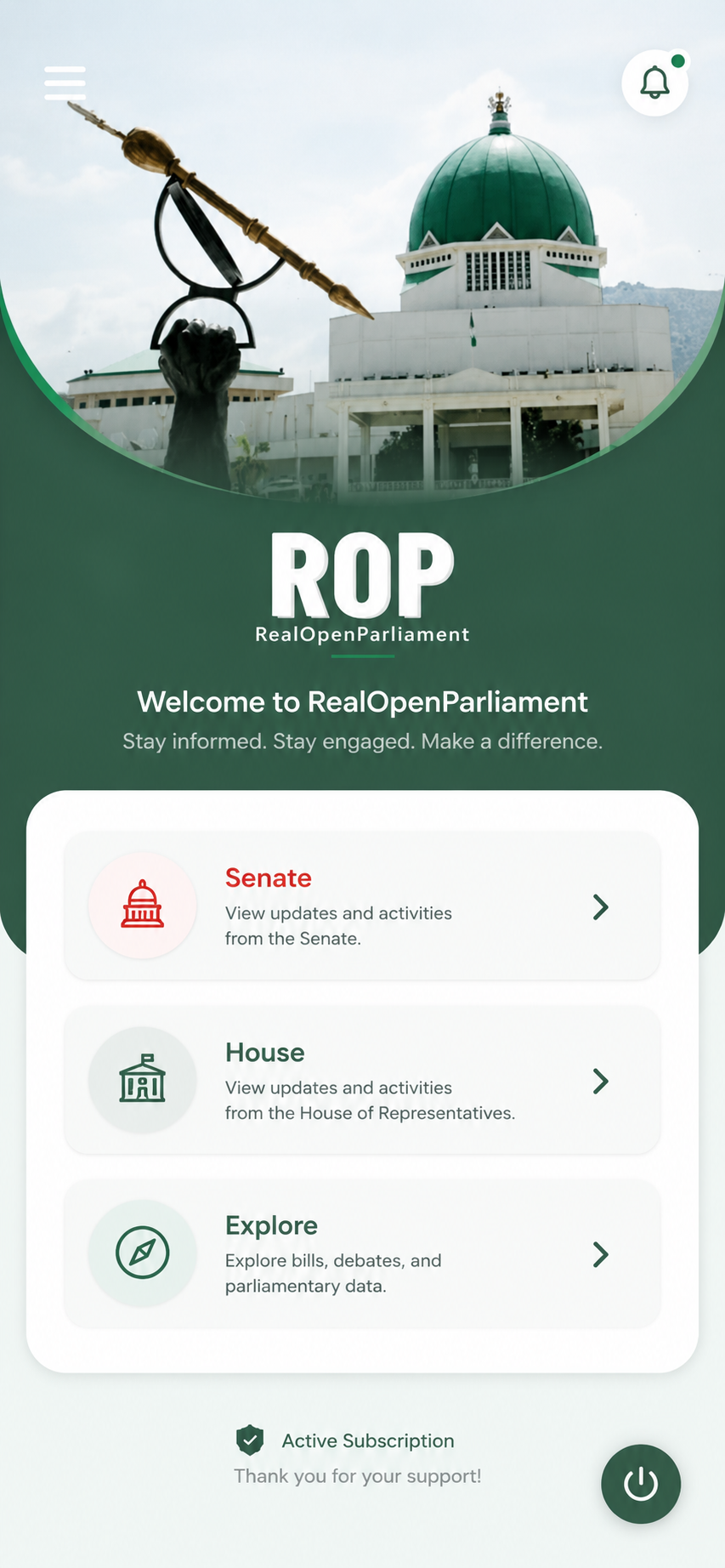
ROP is structured around a simple three-section navigation paradigm. Upon opening the application, users are presented with a root-level menu offering three primary destinations: the House of Representatives, the Senate, and an Explore section. This top-level architecture reflects the bicameral structure of Nigeria's National Assembly and keeps the user experience intuitive and politically accurate
TThe root menu serves as the app's navigational home, presenting users with clear, unambiguous pathways into each legislative chamber and the cross-chamber exploration module. The design prioritises legibility and speed of access, ensuring that a first-time user can orient themselves within seconds.
Access to the House of Representatives — member lists, sessions, and all legislative activities
Access to the Senate — same structure and feature parity as the House module
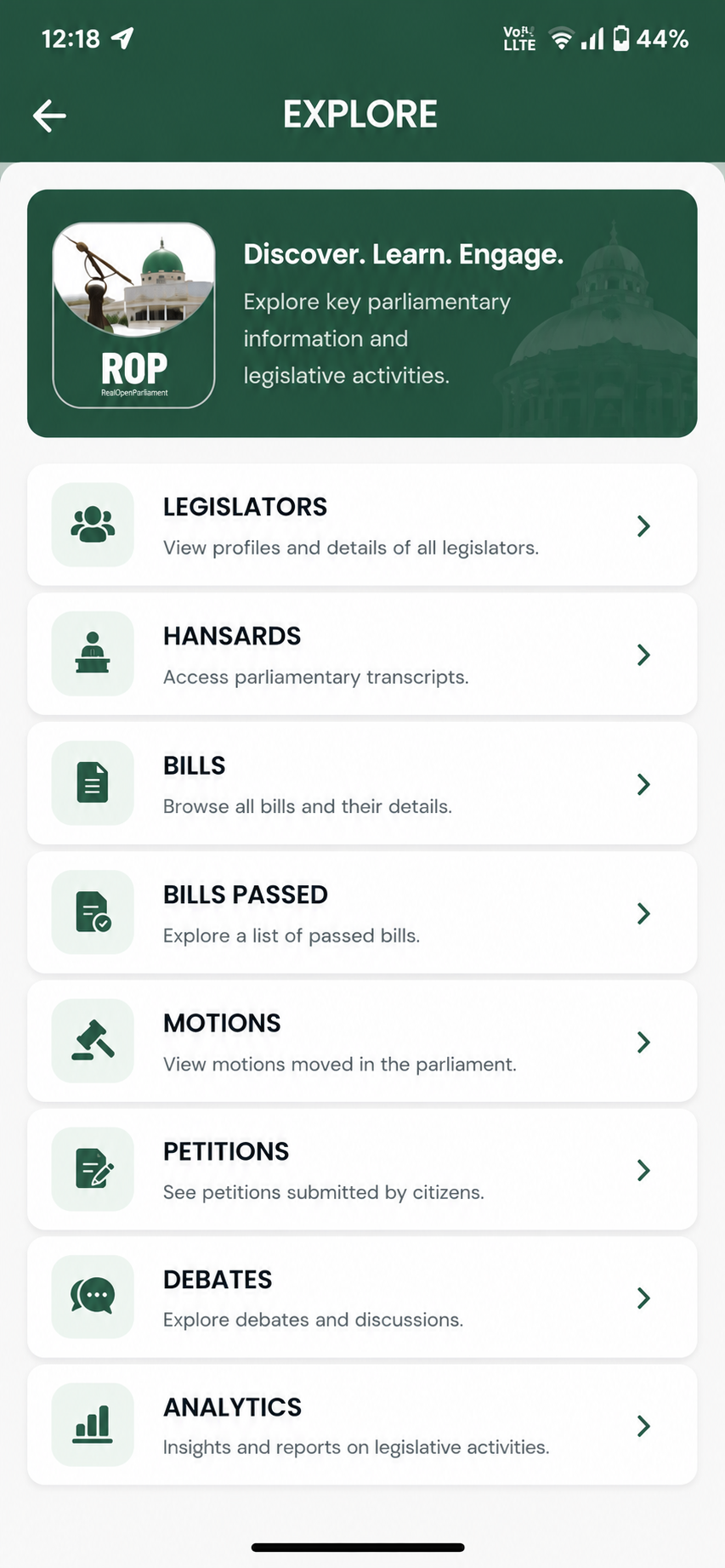
Cross-chamber search, member profiles, analytics dashboard, and parliamentary video debates
Both the House and Senate modules follow an identical structural pattern, ensuring a consistent user experience regardless of which chamber the user is exploring. This architectural parity also simplifies content management for the operator team and reduces the learning curve for end users.
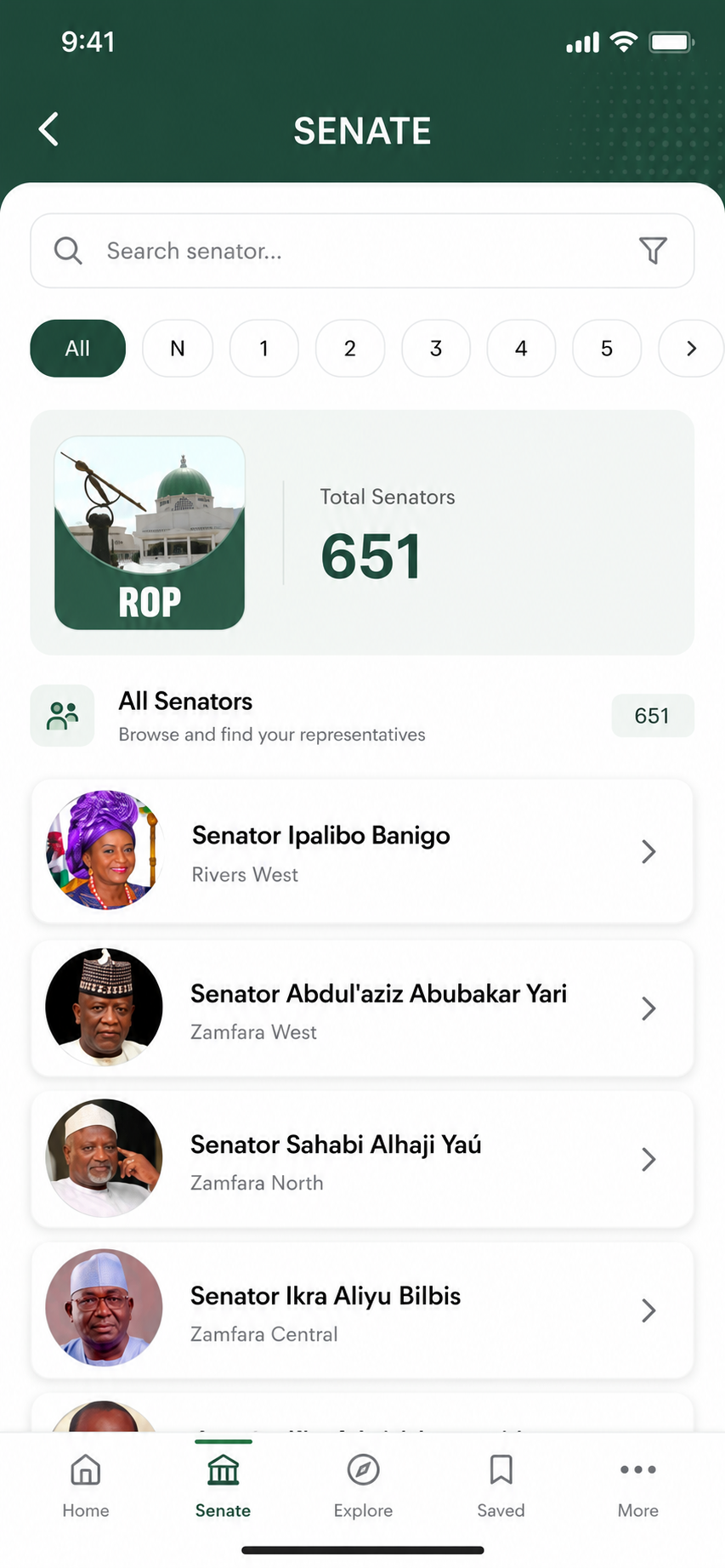
Upon entering either chamber, the user is presented with a complete directory of members belonging to that chamber. Each member entry is a navigable card that leads to the member's individual profile, which is the central unit of content within ROP.
Each chamber presents a chronological list of all parliamentary sessions. This session-based layer allows users to explore legislative activity from a historical perspective — filtering the member list to only those who served during a given session.
Each member's profile is organised into seven distinct content sections, reflecting the full spectrum of parliamentary activity. This structure applies consistently whether the profile is accessed via the chamber directory, a session filter, or the Explore module.
User selects a session from the session list (e.g., 9th Assembly, 2019–2023)
A filtered list of all members who served in that session is displayed
Selecting a member opens their session-specific content profile
Content categories within that profile mirror the global member profile structure
Each member's profile is organised into seven distinct content sections, reflecting the full spectrum of parliamentary activity.
All petitions introduced or co-sponsored by the member, with status and supporting detail
Legislative bills proposed or supported by the member, categorised by stage and subject
Motions moved by the member, including procedural and substantive motions
Debate contributions made by the member, linked to the relevant sitting or reading
Infrastructure and development projects attracted to or executed within the member's constituency
Projects facilitated through the member's legislative influence beyond the home constituency
A timeline of public engagements, community events, and political activities
ROP operates a structured three-tier content model that balances authoritative accuracy with participatory openness. Each tier has clearly defined responsibilities and access controls to preserve data integrity.
The operator team is ROP's primary content authority. This internal team is responsible for entering and maintaining the core legislative record — petitions, bills, motions, and debate contributions — drawing from official Hansard records, NASS publications, and verified parliamentary sources. The operator team ensures that the foundational legislative data within the app is accurate, up-to-date, and canonically correct.
The application serves three distinct stakeholder groups: ordinary citizens seeking transparency, verified member representatives who can publish updates on behalf of parliamentarians, and an operator team responsible for maintaining authoritative legislative records. Together, these roles create a living, continuously updated parliamentary record for Nigeria.
Adding petitions, bills, motions, and debate records for all members
Keeping session and membership data current as the Assembly changes
Reviewing and moderating content submitted by verified member representatives
Ensuring data accuracy through official parliamentary source verification
To enable richer, more granular content — especially for constituency-level activities that are not captured in official Hansard records — ROP allows ordinary citizens to register and apply to become verified representatives of a specific member of parliament.
Upon successful identity verification, a representative gains the ability to create and update content on behalf of their linked member in three specific categories that are outside the operator team's typical remit:
Documenting local infrastructure and development initiatives
Recording externally facilitated projects linked to the member's influence
Publishing event-based updates from the member's public calendar
This model empowers grassroots political communication while confining user-generated content to categories that do not overlap with the official legislative record maintained by the operator team.
Unverified registered users and anonymous visitors can browse all content within the app — member profiles, legislative records, session histories, and analytics — without restriction. The read-only experience is designed to be maximally transparent, reinforcing ROP's core mission of open parliamentary access.
The Explore module is ROP's cross-chamber discovery layer. It offers a unified search and analytics experience that spans both the House and Senate, enabling users to move beyond chamber-specific browsing and engage with parliamentary data at scale.
Users can search for any member across both chambers using name, constituency, state, or party affiliation. The resulting member profile follows the same seven-category content structure described in Section 3.3, giving users a consistent experience regardless of how they reached a given member.
The Explore module surfaces video recordings of parliamentary debates, making the legislative process visually accessible to citizens.
The analytics section transforms raw legislative data into structured, comparative insights.
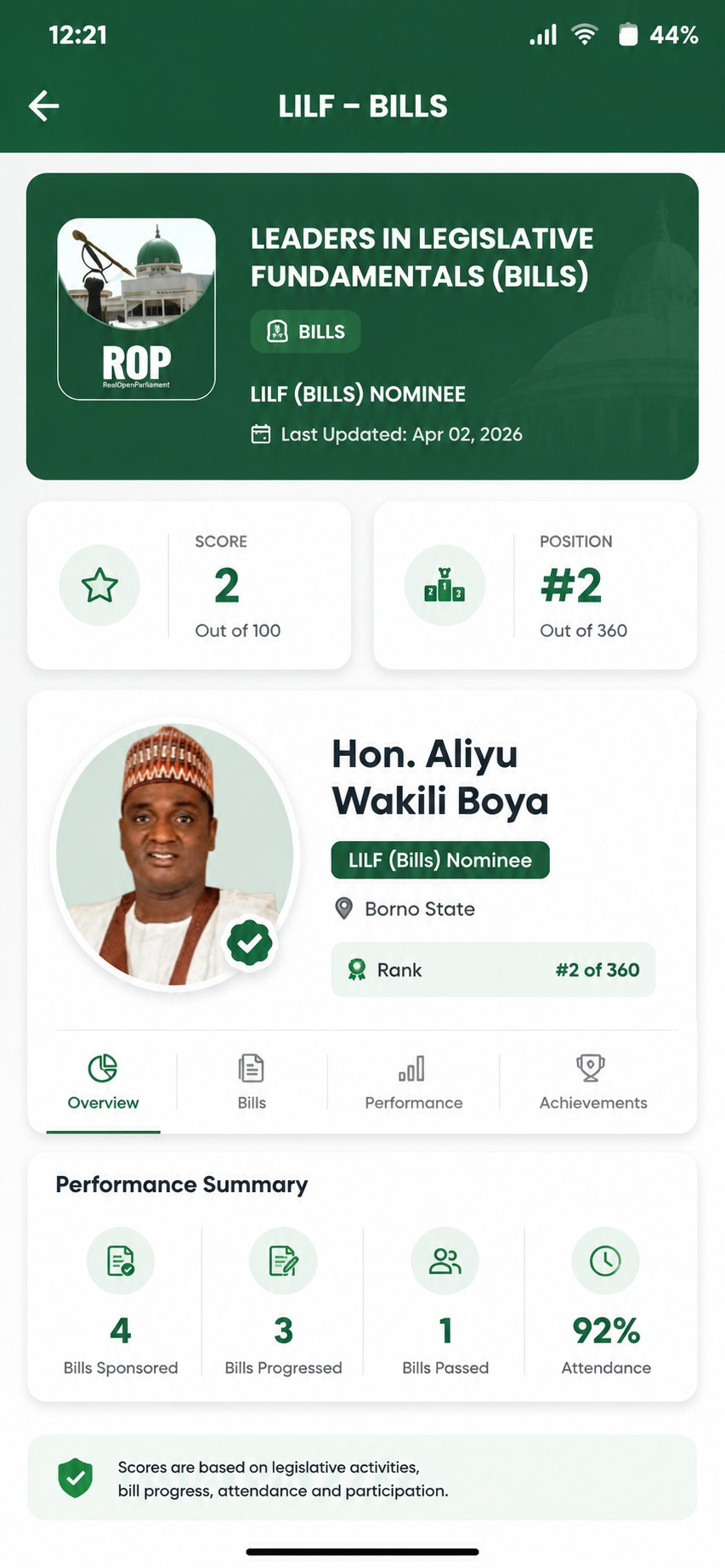
Productivity Appraisal ranks members by their legislative output across one or more fundamental activity categories. Users can filter by activity type — petitions, bills, motions, or debates — and view a ranked leaderboard of members sorted by volume of contribution. This feature answers the question: 'Who is doing the most work in parliament?
Sectorial Analysis provides a macro-level view of parliament's legislative focus. By aggregating bills, motions, and petitions across sectors such as agriculture, education, health, infrastructure, and security, this module reveals where legislative energy is being concentrated — and where it may be absent. Researchers and policy advocates will find this particularly useful for identifying systemic gaps in parliamentary attention.
Productivity Comparison enables side-by-side evaluation of different parliamentary sessions, measuring how a given session performed relative to others in terms of bills passed, motions moved, debates held, or petitions introduced. This historical benchmarking capability is essential for longitudinal accountability and understanding whether the current Assembly is more or less productive than its predecessors
ROP serves diverse user personas, each with a distinct path through the platform.
Opens ROP → selects Senate from root menu
Browses member list or filters by session
Opens member profile → navigates to Bills section
Reviews all bills introduced by the senator
Cross-references with debates to assess speaking record
Shares profile link or screenshots for advocacy purposes
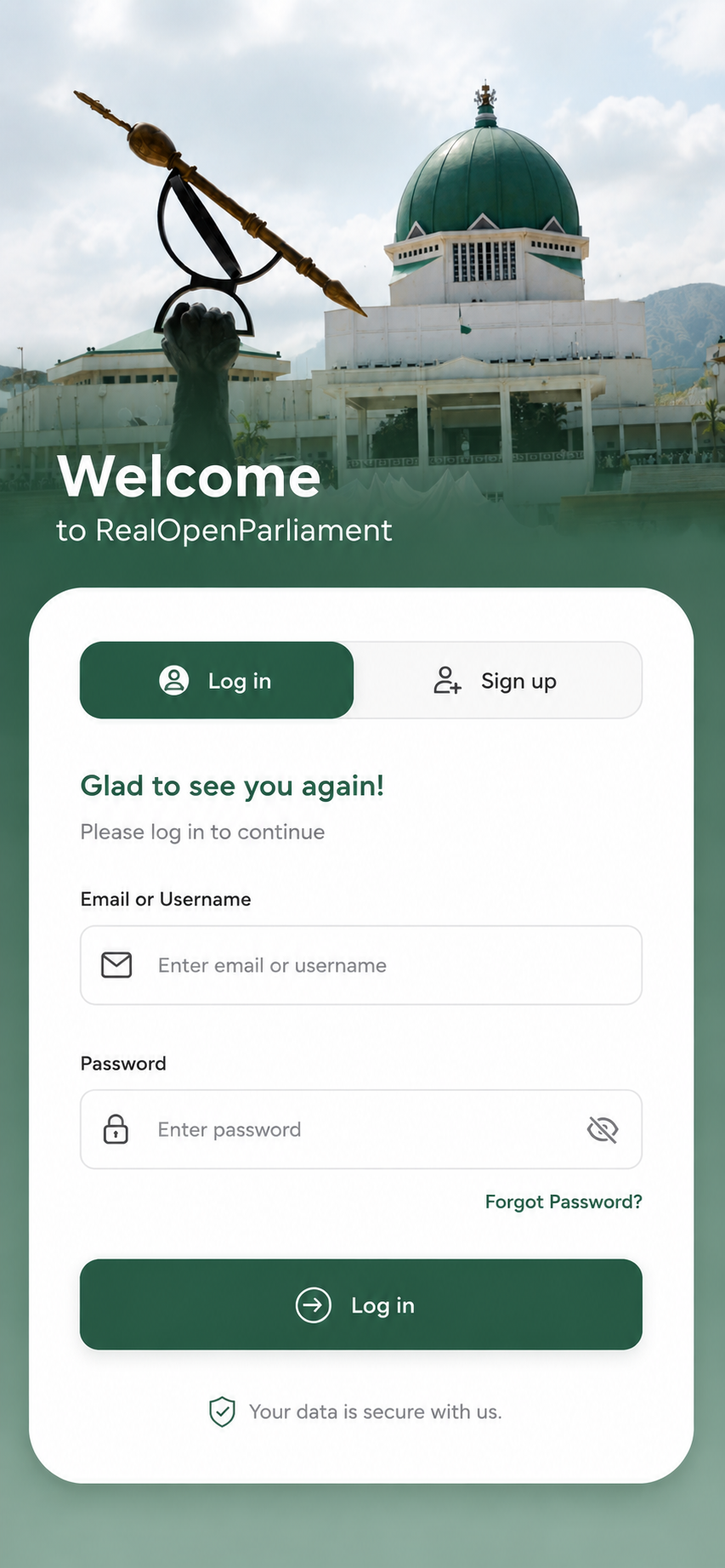
Registers and applies to be verified for a specific member
Completes identity verification process
Gains access to edit constituency projects, attracted projects, diary
Adds a new constituency road project with supporting details
Updates the member's social diary with a recent community event
Opens Explore → navigates to Analytics
Selects Productivity Appraisal → filters by Bills
Views leaderboard of top bill-introducing members across current session
Switches to Sectorial Analysis → selects Health sector
Identifies volume and trend of health-related legislation
Uses Productivity Comparison to benchmark current vs previous session
ROP addresses a well-documented accountability gap in Nigerian civic life: the difficulty ordinary citizens face in accessing and interpreting parliamentary records. By digitising and structuring this data in a mobile-first format, ROP delivers measurable civic value across multiple dimensions.
Citizens can verify the legislative activity of any elected representative at any time, without institutional access or legal expertise
The productivity appraisal and comparison tools create objective, data-driven accountability metrics that go beyond anecdotal assessment
The verified representative model enables grassroots political actors to contribute meaningful content about constituency-level activities
Sectorial analysis and cross-session comparison tools reduce the cost of parliamentary research for journalists, academics, and NGOs
A mobile-first approach ensures that access to parliamentary data is not limited to desktop-equipped, highly educated users
Real Open Parliament represents a significant step forward in the digitalisation of civic participation in Nigeria. By combining structured legislative data, session-based historical records, a participatory content model, and a powerful analytics engine into a single, cohesive mobile application, ROP lowers the barrier to informed democratic engagement.
The application's design — rooted in the actual architecture of Nigeria's bicameral legislature — ensures that it is both structurally accurate and intuitively navigable. Its three-tier content model balances authoritative accuracy with participatory breadth, and its analytics module transforms raw legislative records into actionable civic intelligence.
As ROP grows its user base and content depth, it has the potential to become the definitive reference platform for Nigerian parliamentary accountability — serving citizens, civil society, media, and academic communities alike.
Typically replies instantly