01
City Taxi & Cab Booking Apps (Uber/Ola-Style)
On-demand booking of sedans, hatchbacks, autos and bike taxis with instant fare estimates and live tracking — the core of any ride-hailing app development brief.
Taxi & Ride-Hailing Platforms We Build
iOS (Native & Cross-Platform) · Android (Rider & Driver Apps) · AI (Smart Dispatch & ETA) · API (Maps, Payments & SMS/OTP) · 24/7 Cloud-Ready Operations
On-demand booking of sedans, hatchbacks, autos and bike taxis with instant fare estimates and live tracking — the core of any ride-hailing app development brief.
One-way and round-trip outstation bookings with distance-based fare slabs and driver allotment for longer routes.
Scheduled office pick-up/drop, monthly billing, and centralised trip approval for businesses booking rides at scale.
Lightweight, low-fare ride booking for short-distance urban trips, built for high trip volume.
Package-based bookings by the hour or by the kilometre, for local sightseeing and multi-stop use cases.
High-Intent Ride-Hailing Product Development
A taxi booking app is far more than a "book a cab" button. Behind it sits a real-time driver-matching engine, a dynamic fare and surge-pricing model, a live GPS tracking layer, a payment and driver-payout system, and a dispatch console operators rely on through every rush hour. Businesses evaluating a taxi booking app development company are usually comparing Uber like app development partners on one question: has this team actually shipped a ride-hailing platform end to end, with the rider app, driver app and admin dashboard working as one connected system — not three separate builds stitched together.
We start with the operating model — who books a ride, how drivers get matched and how far they're expected to travel to a pickup, how fares are calculated by vehicle type, distance, time and demand, what happens when a driver or rider cancels, how outstation trips are priced differently from city rides, how drivers get paid out, and what dispatch and support teams need visibility into — then turn those workflows into reliable software. This is the same discovery-first approach behind every cab booking app development company engagement we run, whether it's a city taxi network, a corporate travel platform, or a multi-city ride-hailing launch.
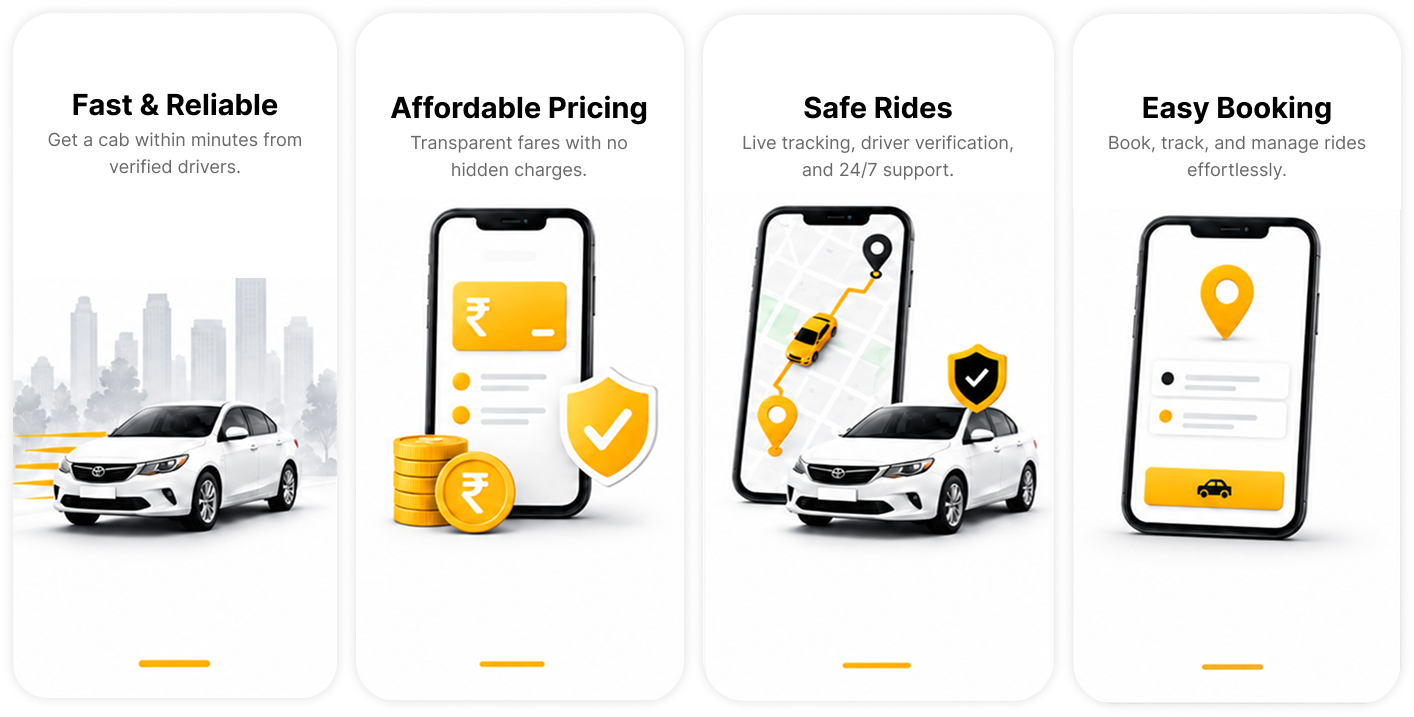
What Every Taxi Platform Needs to Get Right
Instant fare estimates, vehicle-type selection, live tracking and a fast, low-friction repeat-booking flow.
Fair trip allocation, clear earnings visibility, and navigation that works in real traffic conditions.
A live console showing every active ride, idle driver and at-risk booking in one view.
SOS button, live-location sharing with trusted contacts, driver verification and ride-audit trails.
Accurate fare capture, commission logic and on-time driver settlement, every single day.
Taxi App Development Services
Use Algosoft as one accountable product team or add specialist mobile, backend, cloud, AI or QA capacity to your existing team.
End-to-end build of a taxi booking platform tailored to your city, vehicle categories and fare model — not a rebranded template.
Booking, live tracking, fare estimation, saved addresses, ratings and support, built for iOS and Android.
Trip requests, navigation, earnings, document/KYC upload and in-app support for the driver side of the marketplace.
A dispatch console for live trip monitoring, manual assignment override, and zone and fare control.
Real-time GPS tracking app development with accurate ETAs and route guidance for city and outstation trips.
Distance, time, vehicle-type and demand-based pricing, with surge rules configurable per zone and time band.
Document verification, vehicle onboarding, and driver-vehicle assignment that scales past a handful of cars.
An on-demand app with live tracking and payment gateway integration, in-app wallets, and automated driver settlement.
Auditing and re-engineering an existing cab booking platform for performance, scale or new-city launch.
Product Types We Engineer
Your category changes the architecture, dispatch logic and monetisation model. We design the platform around those differences.
The core intracity model — sedans, hatchbacks and autos on demand.
Fast, low-fare short-distance trips built for high trip volume.
One-way and round-trip long-distance bookings with slab-based pricing.
Scheduled pick-up/drop with centralised billing and approval workflows.
Package-based local bookings by the hour or kilometre.
SOS, trusted-contact tracking and verified-driver features built in from day one.
A marketplace layer connecting riders across multiple fleet operators from one app.
Flat-fare, fixed-route booking flows for airport transfers and defined corridors.
Problems We Engineer Around
The taxi app challenges that hurt trip completion rate, driver retention and rider trust — and how we design around each one.
Zone-level demand forecasting and incentive logic keep drivers positioned where bookings actually happen.
A configurable pricing engine separates distance, time, vehicle-class and demand factors so fares stay explainable and correct.
Adaptive location sampling and map-matching keep live tracking accurate without draining driver phones.
Device fingerprinting, cancellation-pattern detection and rider/driver trust scores reduce marketplace abuse.
SOS controls, trip-audit trails and verified driver onboarding are built into the core flow, not bolted on later.
A single ledger reconciles cash, digital payments and commissions so payouts are accurate and auditable.
Complete Feature List
Organised by the rider app, the driver app, and the admin & dispatch dashboard.

End-to-End Process

Rider opens the app, sets pickup and drop points, and selects a vehicle type.
The app calculates an instant fare estimate using distance, vehicle type and live demand.
The booking is broadcast to available drivers within the dispatch radius.
The first driver to accept is assigned; the rider sees live ETA and driver details.
The driver navigates to pickup and starts the trip once the rider boards.
The rider tracks the vehicle live for the duration of the trip.
On drop-off, the fare is settled through the rider's chosen payment method.
Trip data flows into the admin dashboard for revenue, driver payout and performance reporting, and both sides can rate each other.
Integration Layer
| Category | Integrations |
|---|---|
| Maps & Location | Google Maps Platform, Mapbox, geofencing and address autocomplete |
| Payments & Payouts | Razorpay, Stripe, PayPal, UPI, Cashfree and automated driver payout/settlement APIs |
| Communication | Firebase Cloud Messaging, Twilio SMS/OTP, WhatsApp Business API |
| Safety & Verification | Driver background-check APIs, RTO/vehicle verification, SOS/emergency service integration |
| Business Systems | ERP, CRM and accounting software for corporate travel billing |
| Analytics & Growth | Firebase Analytics, Mixpanel, Amplitude, GA4 and AppsFlyer |
Technology Stack
| Layer | Technologies |
|---|---|
| Mobile | Flutter, React Native, Swift, SwiftUI, Kotlin, Jetpack Compose |
| Web & Admin | React, Next.js, Angular, TypeScript, Tailwind CSS |
| Backend & Data | Node.js, NestJS, Python, FastAPI, PostgreSQL, Redis, MongoDB |
| Cloud & DevOps | AWS, Google Cloud, Azure, Docker, Kubernetes, CI/CD pipelines |
| AI & Optimisation | Dispatch-matching algorithms, ETA prediction, dynamic pricing models, fraud detection |
| Realtime & Maps | WebSockets, Google Maps SDK, geofencing, push-notification infrastructure |
Building specifically with Flutter or React Native? Hire Developers from Algosoft's on-demand mobility engineering team, or see our Mobile App Development Company in Noida page for local delivery details.
Delivery Process
Mapping the operating model — vehicle categories, cities, fare rules and dispatch logic — before a single screen is designed.
Booking and tracking flows designed for one-handed use on the road and fast decision-making under time pressure.
A scalable backend, real-time location pipeline and payment/payout ledger built to handle peak-hour concurrency.
Rider app, driver app and admin panel built in parallel sprints with regular demos and feedback loops.
Load testing for peak-hour booking spikes, GPS accuracy testing, and payment/payout reconciliation checks.
Phased city rollout, app-store submission support, and post-launch monitoring and iteration.
Taxi Booking App Development Cost
The cost to build a taxi booking app depends on the number of apps (rider, driver, admin, web), vehicle categories, number of cities, integration depth and safety-compliance requirements. As a starting reference:
| Engagement | Timeline | Scope | Best For |
|---|---|---|---|
| MVP Launch | 8–14 weeks | Rider app, driver app, core booking + tracking flow, payments, basic admin | Validating one city and vehicle category |
| Growth Platform | 4–7 months | Multiple vehicle types, dispatch console, surge pricing, driver payouts, multi-city support | Scaling a proven model across cities |
| Advanced Product | 7–12 months | Outstation + corporate travel, safety suite, AI dispatch/ETA, fraud detection | Multi-market, enterprise-grade platforms |
| Dedicated Team | Rolling monthly | Ring-fenced engineers, designers and QA aligned to your roadmap | Continuous feature delivery post-launch |
Looking for a fixed-scope estimate? Book a Discovery Call and we'll size the build against your city, vehicle-type and integration requirements.
Security, Privacy & Rider Safety
What Changes
Trip completion rate, driver utilisation and dispatch turnaround are the metrics operators watch most closely once a platform goes live. A well-engineered taxi booking app typically improves:
By matching riders to the nearest available driver faster.
Through fair trip allocation and on-time payouts.
By giving operators live visibility instead of phone-based coordination.
Through accurate ETAs, transparent pricing and visible safety features.
See how similar platforms performed post-launch in our Case Studies.
Why Algosoft
Years of building two-sided marketplace platforms where matching, pricing and payouts have to work in real time.
Patchy GPS, low-connectivity zones and mixed vehicle categories are design inputs, not edge cases.
Mobile, backend, dispatch, admin and cloud delivered by one team — no hand-off gaps between vendors.
Dashboards built for the people who run daily operations, not just for demos.
Local presence in Noida with delivery experience across 30+ countries.
Full source code and IP ownership — no lock-in to a shared white-label codebase.
Who We Build For
Related Algosoft Solutions
These related pages may be a better fit for goods movement, fleet operations or broader mobile and AI capability.
Frequently Asked Questions
Cost depends on the number of apps you need (rider, driver, admin, web), how many vehicle categories and cities you launch with, and how deep your payment, mapping and safety integrations go. A focused MVP with one vehicle category, core booking and tracking, payments and basic admin is substantially smaller in scope than a multi-city platform with corporate travel and outstation booking. See the cost table above for reference ranges.
As a guide: an MVP Launch takes 8–14 weeks, a Growth Platform 4–7 months, and an Advanced Product with AI-based dispatch and multi-city support 7–12 months. Timelines depend on scope, integration count and how many platforms (rider, driver, admin) are built in parallel.
Yes. Algosoft is based in Noida, Uttar Pradesh, and has delivered taxi and ride-hailing platforms for clients across 30+ countries — combining local accessibility with international delivery experience.
Yes. We build all three as one connected system — shared backend, shared data model, consistent real-time tracking — rather than three apps stitched together after the fact.
Flutter and React Native cover most ride-hailing use cases efficiently across iOS and Android with a single codebase, which is why we default to them for rider and driver apps. Native Swift/Kotlin becomes worth the extra cost when you need deep background-location performance or platform-specific driver-app requirements at scale.
The driver app streams location at an adaptive interval to keep tracking accurate without draining battery, mapped against road networks (map-matching) rather than raw GPS points, with ETAs recalculated continuously against live traffic.
At minimum: rider sign-up and booking, instant fare estimate, live driver tracking, one or two payment methods, driver onboarding and trip acceptance, and a basic admin panel for monitoring rides and payouts. Surge pricing, corporate travel, outstation booking and advanced safety features can be phased in after the core loop is validated.
Yes. The pricing engine combines base fare, distance, time and a demand multiplier, all configurable per vehicle type, city and time-of-day zone — so surge in one area doesn't affect fares elsewhere.
Every trip is logged against a single ledger that tracks the fare, platform commission, any cash collected by the driver, and the net payable amount. Drivers see running earnings in-app, and payouts are settled on a daily or weekly cycle, fully reconciled against trip records.
Common features include an in-app SOS button, live-location sharing with trusted contacts, driver background verification, trip-audit trails, and ride-sharing of live location via SMS or WhatsApp — all of which we can build in from the MVP stage.
Yes. We design with consent-based data collection, encryption in transit and at rest, PCI-DSS-aligned payment handling, role-based access control and full audit logging across dispatch and pricing changes.
Yes. We start with a technical audit — architecture, code quality, crash and performance data, and current completion-rate/dispatch metrics — then propose a phased re-engineering plan rather than a risky full rebuild, so the business keeps running while the platform improves.
Whether you're launching a city taxi network in Noida, planning a corporate employee-transport platform, or scaling an existing cab booking app across new cities, Algosoft brings one accountable team across mobile, backend, dispatch and cloud.
Typically replies instantly


If you have a project in mind, let’s talk.
-compressed_Webpifier.webp)
-compressed_Webpifier.webp)
-compressed_Webpifier.webp)
-compressed.webp)
.webp)
-compressed.webp)


